


Sparx Reader is integral to the 'Astrea Reads' framework
Astrea Academies Trust, based across South Yorkshire and Cambridgeshire, encompasses 18 schools. Astrea's Director of Secondary Education, Richard Tutt, is emphatic about the trust's disciplinary literacy strategy: from the universal adoption of Teach Like a Champion 'FASE' (fluent, accessible, social, expressive) strategies, creation of a bookletised core curriculum, explicit instruction of Tiers 2 and 3 vocabulary, to implementation of Sparx Reader in 8 schools, Astrea's mission is to expose students to ten thousand words per day and to immerse their pupils in at least 25 uninterrupted minutes of challenging reading daily.
By the end of KS3, all of Astrea's students will have read at least 18 additional literature texts and have had 180 hours of further reading time above the English curriculum. The trust's exacting approach to reading provision - and prioritisation of consistency across all of their academies - has been a core tenet of the central education team's strategy. Their ambition is that every child will leave school reading at or above their chronological reading age, and underpinning that is the notion that 'literature belongs to us all'. It is no surprise that, in under two years, many of the schools within Astrea Academies Trust have radically transformed the quality of the education they offer.
Louise Jackson, Astrea's National Lead for English and Literacy, has driven much of the change in this forward-thinking MAT. In this case study, Louise explains how Sparx Reader is integral to the much-lauded 'Astrea Reads' framework.
Why Sparx Reader?
The parity, adaptability and consistency afforded by Sparx Reader, combined with forensic visibility of reading behaviours for teachers, made it an obvious choice for Astrea. Lacking in rigour and accountability, other reading programmes and typical 'free reading' library lesson set-ups fell short of the high expectations Astrea Academy Trust has for itself. Louise was motivated to find something that gave her visibility of student reading, knowing that “it's really difficult to assess independent silent reading”.
“it's really difficult to assess independent silent reading”
She wanted to find something that would discourage 'path of least resistance' behaviours and to re-train their pupils in the act of attentive reading: “It's just the fact that we're so easily distracted these days. I think Sparx is teaching students to avoid those distractions with reading - we always come back to that idea of careful reading when we talk about Sparx Reader.”
"we always come back to that idea of careful reading when we talk about Sparx Reader.”
“The opportunity to join Sparx fell in line with the same time that we were launching our 'Astrea Reads' framework, and it fit within our Strand Three: encouraging more reading across the schools.”
"encouraging more reading across the schools.”

What does the 'Astrea Reads' framework look like?
The framework is focused and straightforward: a limited suite of projects, done really well and with complete consistency, across a large network of schools:
Strand 1: Astrea Reads Aloud
- All schools restructured their school day to include a daily 25-minute 'Astrea Reads Aloud' tutorial for KS3 as part of the curriculum.
- This strategy provides reading every day for all students.
Strand 2: Reading Intervention
- The weakest readers are supported through different levels of specialised intervention, from systematic synthetic phonics to fluency.
- The exact interventions are consistent across all the schools in the trust, and Louise has ultimate oversight.
Strand 3: Reading in the Curriculum
- Sparx Reader is set as weekly homework for all KS3 pupils.
- A strong English curriculum is in place, which covers a range of voices, genres and time periods.
- A bookletised core curriculum has been implemented, with the aim of exposing students to 10,000 words per day.
What are the non-negotiables that make 'Astrea Reads' so successful?
- One at a time: Louise and her trust directors understand that they can only meaningfully attempt to change one or two aspects of practice at a time, until it becomes a new habit. They are exacting in the nature and amount of new initiatives they introduce.
- Timetable changes: every Principal agreed to adjust their school's timetable, to accommodate a dedicated 25-minute reading session each day (to implement Strand 1).
- Reading time is protected: pastoral issues and tutor time admin are categorically not allowed to encroach on the period.
- Realistic framing: reading is not always framed as reading for pleasure; instead it is seen as exposure to challenging, age-appropriate texts.
- Reading needs a leader: each school's reading lead must be on SLT.
- A coherent meeting programme: Reading Partnership Meetings are thought of as part of a wider programme, rather than one-off sessions. Across the year they build knowledge and understanding of what constitutes excellent practice in reading.
- Marginal gains: systems and processes are streamlined centrally, the implementation of reading tests being one example. Louise provides guidance for schools on exactly how the tests should be administered so that there is no slippage in the process. She has created a step by step guide for conducting the test with students and even sets out how files should be labelled.
- Universal KS3 homework: every school has committed to using Sparx Reader for KS3 homework (Strand 3).

Setting out with Sparx Reader across Astrea:
The team at Sparx Reader met with Astrea's teachers and leaders at the start of the school year to launch the programme - and explain its nuances - to all of the school-based stakeholders. At first staff had questions over how Sparx Reader would support the most able pupils as well as those with lower reading ages, and some parents and teachers reported that it was taking students a long time to complete their homework at first.
This changed when Louise began to emphasise that Sparx Reader has high expectations of how carefully and attentively pupils are reading. Teachers across the trust saw a shift in attitude towards Sparx Reader when they explained to their classes that Sparx Reader is - first and foremost - establishing strong reading processes and habits.
Sparx Reader has high expectations of how carefully and attentively pupils are reading.
Leaders and teachers across Astrea provide as many opportunities as possible for pupils to complete their Sparx Reader homework on time, and - again - there is consistency across the trust in terms of implementation and maintenance of high completion rates. The primary aim is to support all students to make the deadline through constant communication and structured support sessions: two days before homework is due, all Astrea pupils are reminded of the deadline. Any students who have yet to do their Sparx Reader homework the day before the due date are invited to a non-obligatory reading catch up after school, to ensure that they meet the deadline for the next day. Attendance at these pre-deadline sessions is strong. As such, Louise is confident that these systems will ensure at least 90% completion in every class across the entire trust.
The form time group reading (Strand 1) dovetails with the pupils' experience of Sparx Reader. They are being encouraged to read actively, attentively and accountably as a community in form time, and independently through Sparx Reader.
What's changed since adopting Sparx Reader?
- The history of individual pupils' reading on the activity timeline right up to the trust-level reporting has meant that reading has become powerfully visible to everyone, at every level of the organisation.
- Equally, Louise explains that Sparx Reader has positively impacted Astrea's students in other, less quantifiable ways: “when asked 'what was the last book you read?' our pupils can now answer that question because they are actually reading, whereas in the past they would say 'I don't know, I don't read' or just say the text they're studying in their English lessons.”
“when asked 'what was the last book you read?'' our pupils can now answer that question because they are actually reading,

How do you use the Sparx school and trust-level reporting?
- Louise capitalises on the powerful data she has access to. Prioritising transparency, she shares trust-wide data regularly with SLT reading links, line managers for English, Heads of Department and - not least - Principals. Louise knows it's important for schools to see where they stand alongside their Astrea counterparts.
Prioritising transparency, she shares trust-wide data regularly with SLT reading links, line managers for English, Heads of Department and - not least - Principals.
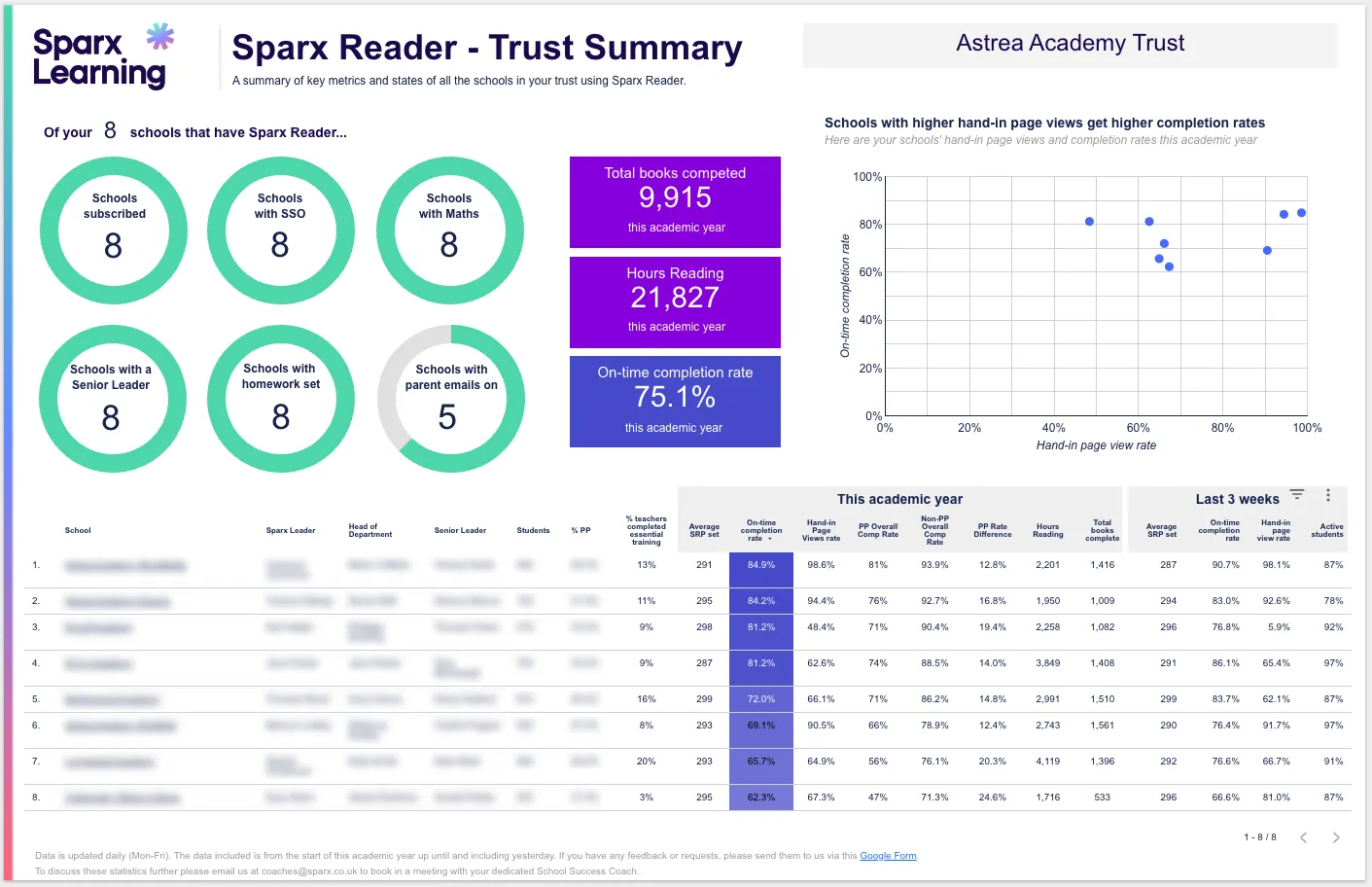
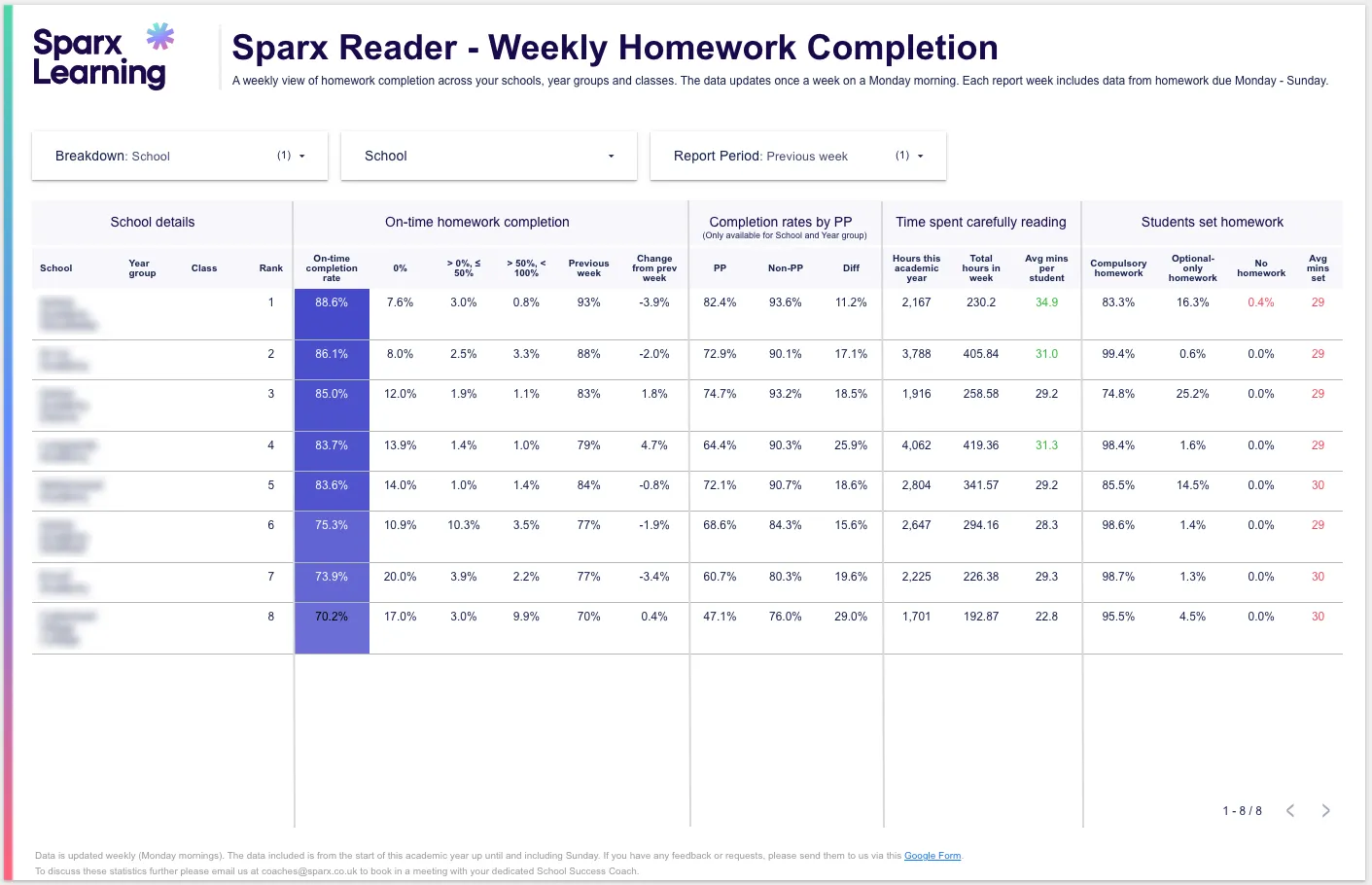
- The central team distributes a comprehensive report to Curriculum Leads, SLT Reading Leads, Principals, Regional Directors, the Director of Curriculum and Assessment, the Director of Secondary Education and the CEO. This report, sent jointly by Sparx Reader and Sparx Maths in a single email includes:
- School rankings in the league table
- Completion rates for both pupil premium and non-pupil premium scholars
- The academy that ranks at the top of the table based on data for the last three weeks.
- The highest-performing year group across the trust.
- As a result of having these high-level data insights, Louise is able to intervene supportively in areas where continuity might be lacking, and act decisively where a school is struggling to maintain high completion. The data is an instrumental part of how she communicates with the schools in her trust.
- Being the National Lead for English and Literacy, Louise is 'the person who thinks about it all' and who is able to spot trends, pockets of great practice and also any irregularities.
- Pupils see the data too. From Sparx Reader leaderboards, percentage of completion for year groups and deadline reminders being digitally displayed around schools, to class and group winners being shown on classroom doors, celebrating success sits at the heart of how the data is used.
Struggling readers and Sparx Reader
- Students who are receiving systematic reading interventions through Strand 2 are enrolled on Sparx Reader in an optional capacity once they've reached a certain level of reading proficiency.
- Pupils who go on to improve their reading up to a broadly age-appropriate level - but who are still receiving regular intervention - are then brought onto Sparx Reader in a limited capacity.
- Their parents are invited into school and given a thorough grounding in how Sparx Reader works; following this, the students are given a target of half the usual amount of SRP (150 instead of 300).
- Interestingly, this set-up has proven to teachers and leaders that these previously struggling readers have not only overcome many of the reading challenges they used to face, but that they are also enjoying feeling successful in their reading: many of the students in this category are reading more than their 150 SRP target! Louise thinks “it's almost as though they want to read more to prove that they can do it.”
“it's almost as though they want to read more to prove that they can do it.”
- Using Sparx Reader in this carefully calibrated way provides assurances that the interventions are working: “so now they're reading out of choice, for pleasure. These are students that couldn't read at the beginning of the year.”
“so now they're reading out of choice, for pleasure. These are students that couldn't read at the beginning of the year.”